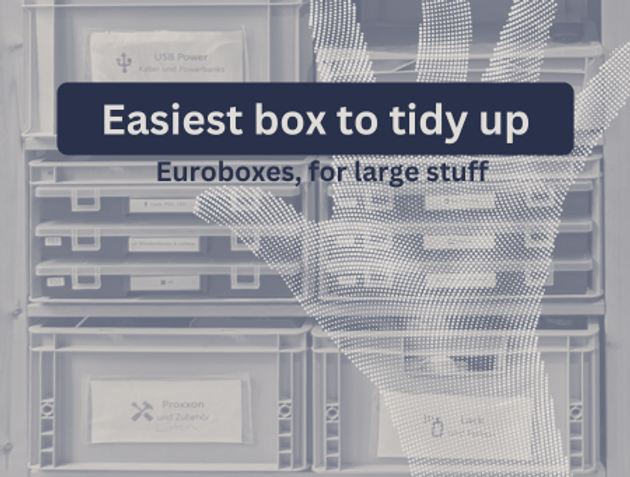
In recent years – actually, decades – I’ve spent a lot of time thinking about order. Not because I particularly enjoy tidying up, but because I’ve repeatedly seen how much a lack of structure slows down creativity and efficiency. Whether in basements, workshops, kitchens, or offices, the same pattern emerges: lots of stuff, little system.
Many people I know – myself included – simply own a lot of things. Tools, materials, spare parts, craft supplies, accessories for hobbies or projects. That’s completely normal if you like to get hands-on. But it often leads to one thing: chaos.
People like to joke, “The fool organizes; the genius masters chaos.” In reality, it’s frustrating for everyone involved – because you’re constantly searching, buying duplicates, or simply losing track.
I also know the opposite extreme: homes that look like they’re straight out of a furniture catalog. Minimalist, perfectly styled – but lifeless. That’s not practical either. Order should be functional and alive – not an end in itself.
Purpose and Scope
The goal of this article is to help you follow your creativity freely – without having to stop and ask, Where did I put that again?
Order isn’t an end in itself. It exists to let you start immediately, because everything is where you need it. That creates room for what matters most – the doing itself.
A pleasant side effect: you save time – when working, shopping, organizing, and storing. Over the years, these small efficiencies add up to a significant advantage.
Most people develop their sense of order intuitively over different life stages. We often inherit habits from our parents or create our own. By midlife, these patterns tend to stabilize. Younger adults usually have to build them from scratch.
This article serves as a shortcut – a fast track for anyone wanting to improve or rebuild their system.
The earlier you start, the greater the benefit. Those who are young or haven’t yet developed clear structures benefit most. Those who already have a working system may find new perspectives here to refine it more consciously.
I want to show you a system – or better, a way of thinking – for building order that lasts.
Core Principles
1. Access Speed
A key principle of good organization is access speed – how quickly you can reach or put something away. It determines where an item should live, how pleasant it is to use, and how much your system supports you day to day.
Every item has an “ideal speed” at which you should be able to reach it – depending on how often you use it and how important it is for a given activity.
| Access Speed | Description | Examples |
| Very fast (1–5 s) | Constantly used items | Mouse, pen, spatula |
| Fast (10–30 s) | Frequently used items | Chargers, notebooks, cooking tools |
| Medium (30–60 s) | Regularly used | Toolbox, archived documents |
| Slow (1–3 min) | Rarely used | Seasonal clothes, decorations, specialty tools |
| Very slow (> 3 min) | Hardly ever used | Keepsakes, spare parts, moving supplies |
Access speed is always relative to place and activity. What’s “fast” in a kitchen (spatula, salt) differs entirely in an office (mouse, notepad). Each space has its own rhythm. You can use this principle to decide intentionally what belongs where.
The result: valuable spaces – like work surfaces, top drawers, or open shelves – are limited and should only be used for items you really use regularly. Everything else belongs in slower zones.
Also consider context and storage requirements: dust protection, safety, or accessibility (e.g., childproofing, humidity). An item’s “ideal spot” depends on both access speed and environmental needs.
2. Grouping
The second pillar of good organization is meaningful grouping. Items belong together not because they look alike or share materials, but because they are used together in daily life.
Activity-Based Groups
Many people start by sorting by category – screws with screws, brushes with brushes, cables with cables. But this often means you have to visit multiple spots for a single task – and you might still not find what you need. Activity-based organization is far more effective.
Example:
- Box Baking & Cooking → Silicone brush, spatula, measuring cup
- Box Painting & Varnishing → Paint brushes, rollers, masking tape
- Box Building & Renovating → Wallpaper brush, putty knife, cutter
This creates a structure that supports both working and tidying. You grab one box – and everything you need is there.
This logic can be hierarchical:
- Level 1: Broad category (Household, Workshop, Office)
- Level 2: Activity (e.g., Painting, Crafting)
- Level 3: Sub-activity (e.g., Glazing, Modeling)
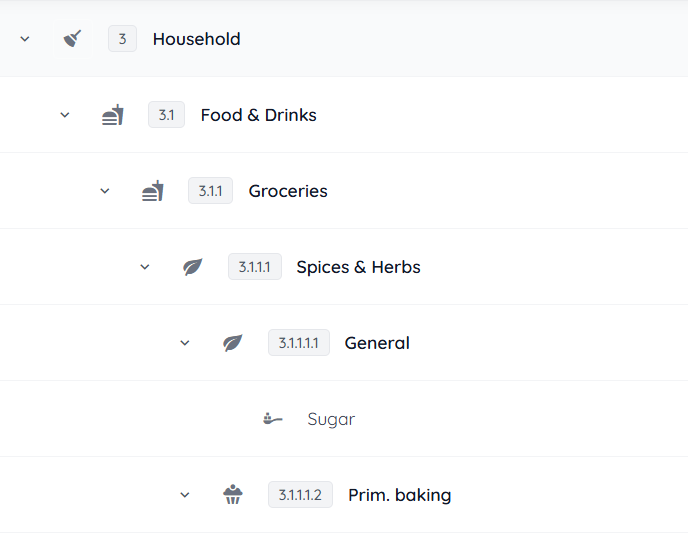
The result is a system that feels intuitive. It’s based on behavior, not aesthetics or material logic.
Structured Chaos
Order doesn’t mean everything must always be perfectly tidy. You need deliberate zones for temporary chaos – places where things can land when there’s no time to put them away properly.
- Drop boxes: Small containers in strategic spots (e.g., at the basement stairs or a central shelf) where you can temporarily store things to sort later.
- Paper collection areas: For letters, notes, or documents that will be processed or filed together later.
- Quarantine boxes: For items you’re unsure about. Give them an “expiration date.” After a few months, decide: keep or let go.
This approach prevents disorder from spreading uncontrollably – it keeps it contained and intentional.
3. Consistency
Another underestimated principle is consistency. When a system is clear and repetitive, it’s easier to maintain because you develop routines and habits.
- Uniform containers: Matching sizes or grids allow easy optimization, efficient drawer use, and instant visual recognition.
- Consistent labeling: Same font size, color, and placement help you identify contents at a glance.
- Visual language: If you use color coding, keep it consistent – e.g., blue for electronics, green for garden, gray for workshop.
Even physical movement can be part of consistency. If you always tidy in the same motion (e.g., drop box left, archive right), you develop muscle memory. That saves energy and time.
Consistency doesn’t mean boredom – it means frictionless flow in daily life.
4. Scalability
A good organization system is alive – it grows with you. Your life changes, hobbies come and go, ways of working evolve. So your system should be built to scale naturally, without constant reinvention.
Example:
- Level 1: Baking
- Level 2: Baking → Decorating
- Level 3: Baking → Decorating → Figures and sprinkles
The key is to choose terms and categories that remain flexible. When you add something new, it should fit naturally, not force a redesign.
Tips:
- Use activity-based terms (e.g., “Serving” instead of “Cutlery”)
- Start broad – refine later
- Regularly check if your system still fits your current needs
A scalable system requires little maintenance because you’re constantly fine-tuning instead of rebuilding from scratch.
5. Conscious Retention
Finally, order isn’t about keeping everything – it’s about deciding deliberately what deserves space.
Ask yourself for each item:
- Can I find it when I need it? – If not, storing it makes no sense.
- How easy is it to replace? – Items that are cheap and widely available shouldn’t take up permanent space.
Example: Printer paper is available anywhere. - What are the storage costs? – Large items silently consume space and money.
Example: A small printer box can easily cost €5–10 per year in space alone. - How quickly does it lose value? – Many items depreciate or become obsolete.
Example: LED bulbs get more efficient each year; ink cartridges dry out.
Conscious retention means balancing availability and cost. You don’t have to throw everything out – just understand why you keep it. Every item you store should have a clear purpose or value.
Outlook
Almost everyone develops structures over time that look surprisingly similar – only customized and usually built with effort.
I’m currently working on a modular organization system that supports this process, formalizes and documents proven methods: easy reorganization, adaptation, and expansion – without chaos, without starting from scratch.
If this topic interests you, follow me on YouTube or visit my website to learn more about the project.